Lessons from a Foxglove
Updated: Feb 8, 2025
I've just returned from England, where foxgloves were in bloom across the countryside—in fields, at roadsides and in gardens, from south to north. So I was especially piqued to see John Ruskin’s writing on this familiar flower in an exhibit at his Lake District home, Brantwood, (which is itself surrounded by vast gardens, including foxgloves!)

Having observed these tall spikes, the flowers along their length, Ruskin muses on imperfection:
It is the sign of life in a mortal body...Nothing that lives is, or can be, rigidly perfect; part of it is decaying, part nascent. The foxglove blossom,—a third part bud, a third part past, a third part in full bloom,—is a type of the life of this world. And in all things that live there are certain irregularities and deficiencies which are not only signs of life, but sources of beauty.
That there could be anything beautiful in what looks like decay, ostensible death, resonates with the Christian faith Ruskin held and struggled with, its promise of life from death. If we look closer at the petals fading and dropping from the foxglove, here we see a vibrant fruit forming, with many tiny seeds inside.
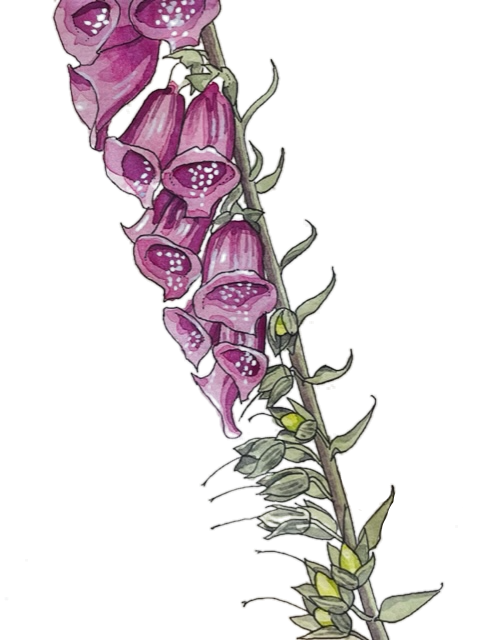
Such yielding observed in nature, the plant relinquishing blossoms to produce seeds, is something Ruskin’s artistic protégé and missionary, Lilias Trotter, explores in her Parables of the Cross and Parables of the Christ-Life.
In the latter, she likens pollination to receiving the Life of God: “in the little flower-heart, while ‘that which is natural’ begins to fade, ‘that which is spiritual’ dawns. The seed-vessel with its hidden treasure—the ultimate object of this miracle quickening—begins immediately to form.” In Parables of the Cross, the surrender of buttercups and irises, gorse and sphagnum, grasses and leaves, witness that death is a threshold to life. "Think of the wonder of it—the Fountain of Life Himself wells up within us, taking the place of all that we have delivered, bit by bit, into His grave. 'I live, yet not I, but Christ liveth in me.'" A wonder indeed!
So even the foxglove blossom which Ruskin describes as spent is nascent—it is not the fresh bud at the plant’s tip but rather a fruit, a death that brings life, deficiency which becomes a source of beauty.
Sources:
John Ruskin, The Stones of Venice, Volume 1, https://www.lancaster.ac.uk/media/lancaster-university/content-assets/documents/ruskin/9-11StonesofVenice.pdf
Lilias Trotter, Parables of the Christ-Life, Facsimile Edition, Lilias Trotter Legacy Inc, 2020
Lilias Trotter, Parables of the Cross, Illustrated Edition, Dodo Press



dự đoán xsmb mình thấy người ta nói hoài nên cũng bấm vô nghía thử cho biết. Mình không đọc kỹ nội dung đâu, chủ yếu xem giao diện có dễ nhìn không vì nhiều trang kiểu này hay rối mắt lắm. Lướt một vòng thì thấy họ làm bố cục khá thoáng, mấy phần nội dung chia thành từng khối rõ ràng nên kéo xuống không bị mệt. Mình cũng thích cách họ trình bày dạng bảng theo cột, nhìn phát là nắm được ý chính, khỏi phải đọc một tràng chữ dài. Menu để ngay chỗ dễ thấy, bấm qua lại vài mục vẫn không bị lạc. Nói chung mới vào lần đầu mà thao tác cũng ổn,…
https://xosoplus.mobi/soi-cau-xsbp.html mình vào thử cho biết vì thấy mọi người hay share. Ấn tượng đầu là họ chia bài theo từng ngày/kỳ nhìn khá dễ theo dõi, kiểu soi cầu Bình Phước hôm nay rồi ghi rõ ngày giờ nên không bị nhầm. Mình không rành mấy thuật toán gì, nhưng phần “bảng chốt số” họ để thành mấy khối riêng nên lướt phát là thấy ngay, nhất là đoạn có “cầu loto VIP” với mấy con lô gan. Trên trang cũng có chèn kết quả kỳ trước ngay dưới nên tiện đối chiếu nhanh mà khỏi mở thêm tab. Nói chung giao diện không màu mè, chủ yếu gom thông tin theo box và tiêu đề rõ ràng nên…
https://keonhacai5.net/ dạo này mình thấy nhiều người nhắc nên cũng bấm vào nghía thử cho biết. Mình không đọc sâu đâu, chủ yếu lướt xem giao diện có dễ dùng không. Cảm giác đầu tiên là trang nhìn khá gọn, các phần được chia theo từng khối nên mắt mình bắt nhịp nhanh, không bị rối khi kéo xuống. Mấy bảng dạng cột hiển thị rõ ràng, nhìn lướt là hiểu ý chính chứ không phải dò từng dòng. Mình cũng để ý cái menu đặt khá dễ thấy, chuyển qua lại vài mục không bị mất công tìm. Nói chung trải nghiệm kiểu “vào xem cho vui” mà lại thấy ổn, vì bố cục chia khu vực rõ và…
siempreeslunes.com hôm bữa mình lướt thấy tên site này nên bấm vào xem thử cho biết. Mình không chơi hay đọc kỹ từng mục đâu, chủ yếu nhìn cách họ trình bày thôi. Cảm giác đầu tiên là giao diện khá “gọn”, các phần nội dung chia theo khối nên kéo xuống không bị ngợp chữ. Có đoạn giới thiệu kiểu cổng game giải trí trực tuyến, nói họ có hệ sinh thái trò chơi phong phú và trải nghiệm hiện đại, đọc lướt cũng hiểu họ muốn hướng tới cả người mới lẫn người chơi lâu năm. Mình thích kiểu tiêu đề to rõ, nhìn phát biết đang ở phần nào, không phải đoán. Nói chung lướt nhanh vẫn…
thapcamtv bóng đá dạo này mình thấy có người nhắc tới khi nói về các nền tảng giải trí trực tuyến nên cũng thử mở vào xem cách họ bố trí giao diện ra sao. Mình không đi sâu vào nội dung hay từng trò cụ thể, mà chủ yếu quan sát cách các chuyên mục được phân chia trên trang và cách thông tin hiển thị cho người dùng. Nhìn tổng thể thì các khu như thể thao, casino, game bài hay slot thường được sắp xếp theo từng nhóm khá rõ, hiển thị dạng khối và danh sách nên lướt qua cũng dễ theo dõi. Các bảng dữ liệu được trình bày dạng cột khá gọn, giúp quan…